Monday, November 17, 2008

Sunday, November 9, 2008
Some Useful Links......
- About ODF (Open Document Format)
- Importance and Benefits of Open Standards
- FOSS Open standards/Government National Open Standards Policies and initiatives
- Networked and e-Governance
- What is Good Governance?
- Challenges in Implementing Open Standards in Govt. Procurement Policies
- e-Government
- Dr.DC Misra's eGov Blog
Wednesday, October 8, 2008
ODF OLYMPIAD 2008
Submissions begin on SOFTWARE FREEDOM DAY September 20, 2008. ODF is an international standard for office productivity format, adopted by ISO. ODF is fundamental to enabling computer education globally.ODF is the National Standard of countries such as South Africa and Uruguay.ODF is easy to learn and specifies the way documents, presentations and spreadsheets are stored in a computer by popular Office Productivity Free/Libre and Open Source Software such as Open office Anyone who has used any presentation software can immediately start using ODF software such as OpenOffice.org

Follow the link for further details : http://www.odfolympiad.org/
Topics and Categories (for Indian students)
Up to Class V -Why should I learn Computers?
Class VI to VIII -Benefits of Open Source Software to my school
Class IX & X -Open Standards: Freedom from Digital Divide
Class XI & XII -Importance of Open Standards for good Governance
Evaluation Parameters for the ODF Olympiad Trophy
- Relevance of topic
- Creativity & Visual Appeal
- Organisation of the content
- Use of embedded tools (e.g. spreadsheet)
ODF OLYMPIAD PROCESS
- Create presentation in ODF using OpenOffice.org or any other Free/Libre and Open Source, ODF compliant software.
The presentation should not have more than total of 21 slides (including introduction and Thank you slide)
The presentation file size should not exceed 1MB
Each Slide should not have more than two clicks for navigation
Email the presentation to india@odfolympiad.org along with your details.- Name, Class, School Name, School Address, Email Address, Phone number, Age before 15th November, 2008
The Subject of the email must be in the following format
for example "Category II, Gandhi National School"
Wednesday, October 1, 2008
Thursday, September 25, 2008
Wednesday, September 10, 2008
Some Interesting Links for students (C++)
- Conditional Operator
- Increment and Decrement Operators
- The WHILE Loop
- Ending a Program or Loop Early
- The DO-WHILE Loop
- The FOR Loop
- Which Loop Should I Use?
- Nested FOR Loops
- Using Functions in C++
- Creating User-Defined Functions
- Style 1: void functionName(void)
- Style 2: void functionName(argument(s))
- Style 3: non-void functionName(void)
- Style 4: non-void functionName(argument(s))
Tuesday, September 9, 2008
Increment and Decrement Operators in C++
Saturday, July 26, 2008
Monday, July 14, 2008
Computer Fundamentals : Functional Components and interconnection
Please follow the link for ASSIGNMENT (Computer Fundamentals)
Last Date for Submission : 4th August, 2008
Practice Assignment : File Handling in C++

Dear Students
Assignment-1
Assignment-2
File Handling in C++
- Creating a text file
- Displaying contents of text file
- Creating Binary File
- Showing Contents of binary files
- Adding more records at the end of file (app mode)
- Updating binary files
- deletion of a record from file (2 file method)
- Modification of a record (using two files)
- insertion of a record in sequential file ( using 2 file)

Tuesday, July 8, 2008
Getting Started with C++
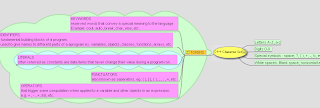
This mind map is to help students who are starting with C++ Programming Language.
Introduction to C++
C++ originated with Bjarne Stroustrop. In the simplest sense, if not the most accurate, we can consider it to be a better C. Although it is not an entirely new language, C++ represents a significant extension of C abilities. We might then consider C to be a subset of C++. C++ supports essentially every desirable behavior and most of the undesirable ones of its predecessor, but provides general language improvements as well as adding OOP capability. Note that using C++ does not imply that your are doing OOP. C++ does not force you to use its OOP features. You can simply create structured code that uses only C++'s non-OOP features.
Monday, July 7, 2008
File Handling in C++
Saturday, May 24, 2008
Computer Science : Project ( C++ )
Project content (Class XII)
Project for class XII should ensure the coverage of following areas of curriculum:
a. Problem Solving
b. Data Structure
c. Object Oriented Programming in C++
d. Data File Handling
Theme of the project can be
• Any subsystem of a System Software or Tool
• Any Scientific or a fairly complex algorithmic situation.
• Business oriented problems like
Banking,
Library information system,
Hotel management system,
Hospital management system,
Transport query system
Result Processing
LAB Management System (Chem. , Phy. Computer Lab etc)
Pay Roll
• Quizzes/Games
• Tutor/Computer Aided Learning Systems
The aim of the project is to highlight the abilities of algorithmic formulation, modular programming, optimized code preparation, systematic documentation and other associated aspects of Software Development.
The assessment would be through the project demonstration and the Project Report, which should portray Programming Style, Structured Design, High Cohesion, Good documentation of the code to ensure readability and ease of maintenance.
To Know about Computer Project report --> Click Here <--
Friday, May 9, 2008
Summer Vacations : Assignment
KULACHI HANSRAJ MODEL SCHOOL
CLASS XII
COMPUTER SCIENCE (083)
HOLIDAYS HOMEWORK(2008-09)
Q1. Complete and submit a CD with programs and assignment register on following subtopics from the given list of programs:
- Series
- Structures
- Enumerated data types
- Macro
- Classes
- Constructors
The printout to be taken in school lab after the school reopens. Submit the practical file with above-mentioned programs by 10th July ’2006.
Q2. Declare appropriate classes and design the menu for the project topics alloted to your group.
The Subprogram must be submitted on the CD.
Saturday, April 26, 2008
typedef
USER DEFINED DATA TYPES : typedef
We have already seen a data type that is defined by the user (programmer): The structures. But in addition to these there are other kinds of user defined data types:
Definition of own types (typedef)
C++ allows us to define our own types based on other existing data types. In order
to do that we shall use keyword typedef, whose form is:
typedef existing_type new_type_name ;
where existing_type is a C++ fundamental or any other defined type and new_type_name is the name that the new type we are going to define will receive. For example:
typedef char C;
typedef unsigned int WORD;
typedef char * string_t;
 Click here for detailed notes.........
Tuesday, April 22, 2008
Assignment : Structure in C++
Click Here for Assignment(pdf format).........

User Defined Data Type in C++ : Structure
Structures in C++
A structure is a group of data elements grouped together under one name. These data elements, known as members, can have different types and different lengths. Structures are declared in C++ using the following syntax: struct structure_name
{
member_type1 member_name1;
member_type2 member_name2;
member_type3 member_name3;
:
:
} object_names;
example :

    struct product
    {
     int weight;
   float price;
    } ;

product apple;
product banana, melon;
Subtopics Covered
Defining a Structure
Declaring structure variables
Accessing structure elements
Passing structure to Functions as value and reference argument/parameter
Function returning structure
Array of structures
passing an array of structure as an argument/ a parameter to a function
Tuesday, April 15, 2008
Data Structures (1 D & 2 D Arrays)
Array
It is a static data structure. It is a homogeneous collection of data. The elements in the array are stored on consecutive memory locations. Array is also known as a subscripted variable, e.g., A[i] is ith element of the array A (i.e., i is the subscript with variable A). As we know that the elements of the array are stored on consecutive memory locations, it becomes convenient to find out the address of memory location of ith element, for given base address (address of first element) and W (i.e. the number of memory locations required by one element).
Different Operations on 1 D ARRAYS
- Creation
- Traversal
- Insertion
- Deletion
- Searching
- Linear
- Binary Search
- Sorting
- Bubble Sorting
- Selection Sorting
- Insertion Sorting
- Merging
Different Operations on 2 D ARRAYS
- Creation
- Printing (Traversal)
- Addition of two Matrix
- Difference Matrix
- Multiplication of Matrix
- Row / Col Sum
- Diagonal Sum
- Transpose Matrix
Monday, April 7, 2008
LIST OF PROGRAMS FOR CLASS XII (2008-09)

click Here......
Assignment : 1D Array & 2D Array


Sunday, March 30, 2008
Binary Search Function (Presorted Array)

Saturday, March 29, 2008
Algorithm for converting INFIX Exp. To POSTFIX Exp.


Thursday, March 27, 2008

Monday, March 24, 2008
Problem Solving Session Schedule
- Students can come to school if they have any Problem.
- Students can communicate through email or they can contact through Phone
- Students should be in their SCHOOL UNIFORM when they come to school.
- Reporting Time : 8:00 am
Practice Assignments/Questions
(These Practice Questions are in PDF format and will require Acrobat Reader.)
Thursday, January 24, 2008
Sample Question for viva
http://www.keepandshare.com/doc/view.php?id=365605&da=y
Wednesday, January 23, 2008

Monday, December 24, 2007
An Inspiring Story for all the students.........
- This simple story illustrates profound meaning in life.
- It teaches us to see life situation in different perspectives, angles.
- It motivates and inspires us to be a better person ourselves. :)


Tuesday, December 18, 2007
SAMPLE PRACTICAL QUESTION PAPER

NOTE :
- Take the above Question paper just as a guideline for your Board Pr Exam.
- The Programming questions can be from any topic in your syllabus( Check the CBSE Syllabus given in previous post as it is taken straight from CBSE site http://www.cbse.nic.in/curric~1/xii06/compscie.pdf
- Students are supposed to submit program SOURCE CODE and OUTPUT Printouts
Computer Science (Code 083) (Practicals)
Class XII (Practicals)
(As per CBSE Syllabus)
Computer during the examination. Marks are allotted on the
basis of following:
Documentation/Indentation
Output presentation
the following topics
• Array of structure
• Stack using arrays and linked implementation
• Queue using arrays (circular) and linked implementation
• Binary File operations (Creation, Displaying, Searching and modification)
• Text File operations (Creation, Displaying and modification)
2. SQL Commands (05 Marks)
Five Query questions based on a particular Table/Relation to be tested
practically on Computer during the examination. The command along
with the result must be written in the answer sheet.
3. Project Work (05 Marks)
The project has to be developed in C++ language with Object Oriented
Technology and also should have use of Data files.
• Presentation on the computer
• Project report (Listing, Sample, Outputs, Documentation
• Viva
4. Practical File (05 Marks)
Must have minimum 20 programs from the following topics
5. Viva (05 Marks)
Based on C++ ,Project, SQL
Friday, December 14, 2007
Computer Science Project Report (C++)
- Certificate
- Acknowledgment
- Overview of C++
- Need for the Project/Synopses/Summary
- Requirements(hardware & Software) along with instructions regarding how to install the project and use it are to be given. It should be a sort of USER MANUAL
- Header Files (used in the Project along with the functions each file is supporting in the project.)
- Classes & Objects( Description of user defined classes and their purpose)
- Functions ( Description of user defined functions and their purpose)
- Source Code(listing of all the programs prepared as part of project. )
- Output (Dumps of all the output screens)
- Shortcomings
- Bibliography
- Index to be placed after Acknowledgment in the report but NOT to be mentioned in the index.
- Running project Source Code to be submitted in a CD along with relevant data files
- Project CD should be properly LABELED with
- Class : XII
- Section : A/B/E
- Year : 2007-08
- Class Roll No. :
- BOARD ROLL No. ( To be mentioned later)
- Project TITLE : Tutorial - Water Cycle (Example)
- Main Program name : (.CPP File name)
Wednesday, December 12, 2007
Mindmap : K-Map method of Minimization of Boolean Exp

Friday, December 7, 2007
Thursday, December 6, 2007
ASSIGNMENT (Boolean Algebra)
| Q1. | | Design NAND-to-NAND circuit for the following expressions |
| | a. | XYZ’ + X’Y’Z |
| | b. | A’B.(A’B’C’ + B’C) |
| | c. | A’B’C’ + A’B’C + A’BC + ABC’ + ABC |
| | d. | (X + Y’).Z |
| | e. | Y’ Z + Z X’ |
| | f. | (A+B) (B+D) |
| | g. | 3 input AND gate |
| | h. | 3 input OR gate |
| Q2. | | Design NOR-to-NOR circuit for the following expressions |
| | a. | X(Y’ + Z’) + XY’ |
| | b. | A’B.(A’B’C’ + B’C) |
| | c. | X.Y’ + Z |
| | d. | (X + Y) (Y + Z) (X+Z) |
| | e. | F(A,B,C) = (A+B’) (B+C) |
| | f. | F(X,Y,Z) = (X’+Y) (Y’+Z) |
| | g. | (A’+B’+C’) (A+B’+C’) (A+B+C’) |
| Q3. | | Obtain a simplified form of a Boolean Expression using Karnaugh Map |
| | a. | F(W,X,Y,Z)=S(2,3,6,10,11,14) |
| | b. | F(A,B,C,D)=S(0,1,3,45,6,7,9,10,11,13,15) |
| | c. | F(A,B,C,D)=P(0,1,3,45,6,7,9,10,11,13,15) |
| | d. | F(X,Y,Z)=P(3,4,5,6,7) |
| | e. | F(A,B,C,D)=S(0,1,2,5,6,8,9,10,13,15) |
| | f. | F(W,X,Y,Z)=S(2,3,6,10,11,14) Find expression in POS form |
| | g. | F(X,Y,Z)=S (3,4,5,6,7) |
| | h. | F(U,V,W,X)=S(7,9,10,11,12,13,14,15) |
| | i. | F(U,V,W,X)=P(0,2,3,7,8,10,11) |
| | j. | F(U,V,W,X)=P(3,4,5,6,7,9,11,12,13,14,15) Draw circuit diagrams for the simplified Boolean Expression |
Q4. Find the minimal SOP expressions for F1 and F2 using K-Map for the given truth table for a function F(X,Y,Z), X Y Z F1 F2 0 0 0 0 1 0 0 1 1 0 0 1 0 0 0 0 1 1 1 1 1 0 0 0 1 1 0 1 1 0 1 1 0 0 1 1 1 1 1 1 Q5. A combination circuit has 4 inputs and single output. Output is 1 if
· Write Canonical SOP and POS forms of expressions ·Simplify using K-Map (Both SOP and POS expressions) ·Draw logic circuit diagram for simplified expression Q6. A truth table having 4 input variables ( A, B, C, D) has an output 1 when ABCD=0001 ABCD=0110 ABCD=1110 Q7. Evaluate logic circuit diagram
Q8. Evaluate Boolean expression Q9. Simplify using algebric method
Q10. Verify the following :
Q11. Write dual of following: 1. (x+y’) 3. a+1.bc Q12. Write complement of following: 1. x’yz’ + x’y’z 3. xy(y+z) Q14. State and verify Involution Law using truth table. Q15. State and verify Idempotent Law using truth table. Q16. State and verify Distributive Law using truth table. Q17. State and verify DeMorgan’s Law using truth table. |

Wednesday, December 5, 2007
Karnaugh Map Minimizer (Free Download)
Karnaugh Map Minimizer is free (GPL) software for minimizing boolean functions using the graphic method of Karnaugh maps. I am giving its link for downlods for educational purposes so double check the output if you intend to use it for any "real" work. I hope it helps you with the topic….