Programming Methodology
View SlideShare presentation or Upload your own.


Introduction to C++
C++ originated with Bjarne Stroustrop. In the simplest sense, if not the most accurate, we can consider it to be a better C. Although it is not an entirely new language, C++ represents a significant extension of C abilities. We might then consider C to be a subset of C++. C++ supports essentially every desirable behavior and most of the undesirable ones of its predecessor, but provides general language improvements as well as adding OOP capability. Note that using C++ does not imply that your are doing OOP. C++ does not force you to use its OOP features. You can simply create structured code that uses only C++'s non-OOP features.
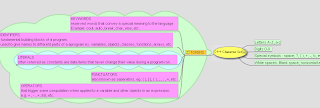
Project content (Class XII)
Project for class XII should ensure the coverage of following areas of curriculum:
a. Problem Solving
b. Data Structure
c. Object Oriented Programming in C++
d. Data File Handling
Theme of the project can be
• Any subsystem of a System Software or Tool
• Any Scientific or a fairly complex algorithmic situation.
• Business oriented problems like
Banking,
Library information system,
Hotel management system,
Hospital management system,
Transport query system
Result Processing
LAB Management System (Chem. , Phy. Computer Lab etc)
Pay Roll
• Quizzes/Games
• Tutor/Computer Aided Learning Systems
The aim of the project is to highlight the abilities of algorithmic formulation, modular programming, optimized code preparation, systematic documentation and other associated aspects of Software Development.
The assessment would be through the project demonstration and the Project Report, which should portray Programming Style, Structured Design, High Cohesion, Good documentation of the code to ensure readability and ease of maintenance.
To Know about Computer Project report --> Click Here <--
CLASS XII
COMPUTER SCIENCE (083)
HOLIDAYS HOMEWORK(2008-09)
The printout to be taken in school lab after the school reopens. Submit the practical file with above-mentioned programs by 10th July ’2006.
Q2. Declare appropriate classes and design the menu for the project topics alloted to your group.
The Subprogram must be submitted on the CD.
USER DEFINED DATA TYPES : typedef
C++ allows us to define our own types based on other existing data types. In order
to do that we shall use keyword typedef, whose form is:
typedef existing_type new_type_name ;
where existing_type is a C++ fundamental or any other defined type and new_type_name is the name that the new type we are going to define will receive. For example:
typedef char C;
typedef unsigned int WORD;
typedef char * string_t;
 Click here for detailed notes.........

struct structure_name
{
member_type1 member_name1;
member_type2 member_name2;
member_type3 member_name3;
:
:
} object_names;
example :

    struct product
    {
     int weight;
   float price;
    } ;

product apple;
product banana, melon;
Subtopics Covered
Defining a Structure
Declaring structure variables
Accessing structure elements
Passing structure to Functions as value and reference argument/parameter
Function returning structure
Array of structures
passing an array of structure as an argument/ a parameter to a function
Array
It is a static data structure. It is a homogeneous collection of data. The elements in the array are stored on consecutive memory locations. Array is also known as a subscripted variable, e.g., A[i] is ith element of the array A (i.e., i is the subscript with variable A). As we know that the elements of the array are stored on consecutive memory locations, it becomes convenient to find out the address of memory location of ith element, for given base address (address of first element) and W (i.e. the number of memory locations required by one element).
Different Operations on 1 D ARRAYS
Different Operations on 2 D ARRAYS